


July
Distillation
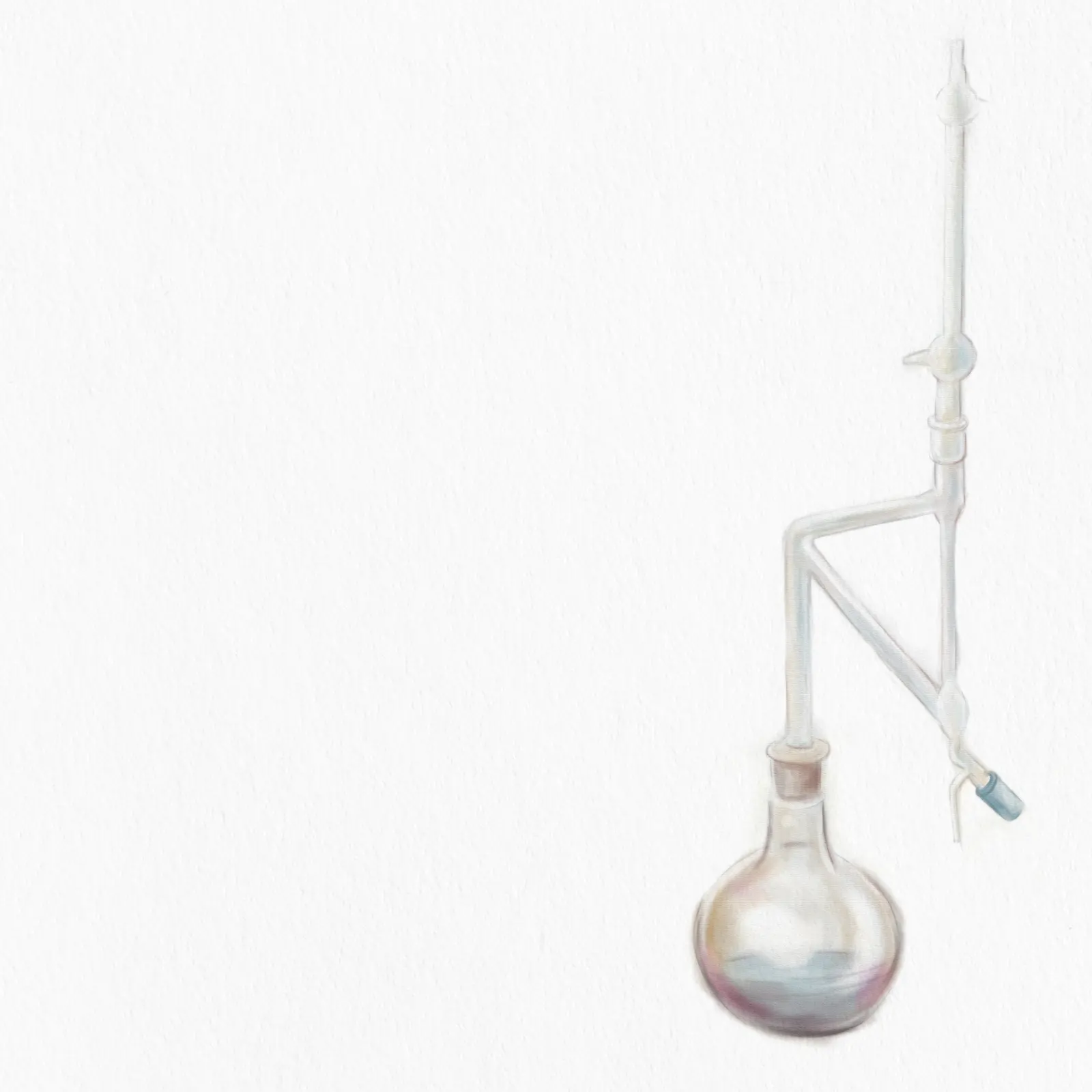
Distillation is a process in which the components of a liquid mixture are separated based on their differing boiling points. The essence of the process involves evaporating a portion of the mixture and then cooling and condensing the resulting vapor to obtain a pure liquid. This technique is fundamentally important in the practices of chemistry, food industry, and pharmaceuticals.

The distillation process
During distillation, the mixture is heated in a distillation flask. As the temperature rises, the elements of the mixture evaporate at their corresponding boiling points. The evaporated vapors are then directed into a cooling device (condenser), where they cool down and revert to a liquid state. The resulting product contains the components of the original mixture in a purer form.
There are two main types of distillation:
- Simple distillation, which is used to separate mixtures whose components have significantly different boiling points.
- Fractional distillation, which is applied to more complex mixtures where the differences between boiling points are smaller.
Applicability
Distillation plays a key role in the pharmaceutical industry, particularly in the production of pure solvents and active ingredients. The purification of solvents through distillation is essential for drug manufacturing, as the presence of contaminants can affect the effectiveness and safety of the final product.
Additionally, distillation is widely used in the extraction of essential oils, which are found in many pharmaceutical formulations. Essential oils are extracted from plant materials through distillation, and the resulting products are used for various medicinal purposes.
Did you know?
- The technique of distillation was known to ancient civilizations. The first known distillation device was used in ancient Mesopotamia, around 3000 BC.
- Distillation also plays an important role in the production of alcoholic beverages. During the production of whisky, vodka, rum, and other spirits, distillation is used to separate alcohol from fermented mixtures, resulting in pure, high-alcohol beverages.
- In the petroleum industry, distillation is widely used. Crude oil is processed through fractional distillation to extract various products, such as gasoline, kerosene, and diesel.
- In laboratories, different distillation methods are employed to purify and identify compounds. For example, azeotropic distillation is used to separate mixtures that cannot be completely separated by normal distillation.
Overall, distillation is a versatile and fundamentally important process that is essential in numerous industries and everyday life.